
Opinion
I was having a discussion recently with a few local business leaders about advertising, marketing and where businesses are spending their money today.
As usually happens when you get a few business people together, one topic led to another. We talked about social media, traditional advertising, digital marketing and eventually streaming services.
Then someone brought up a point that made us stop and think.
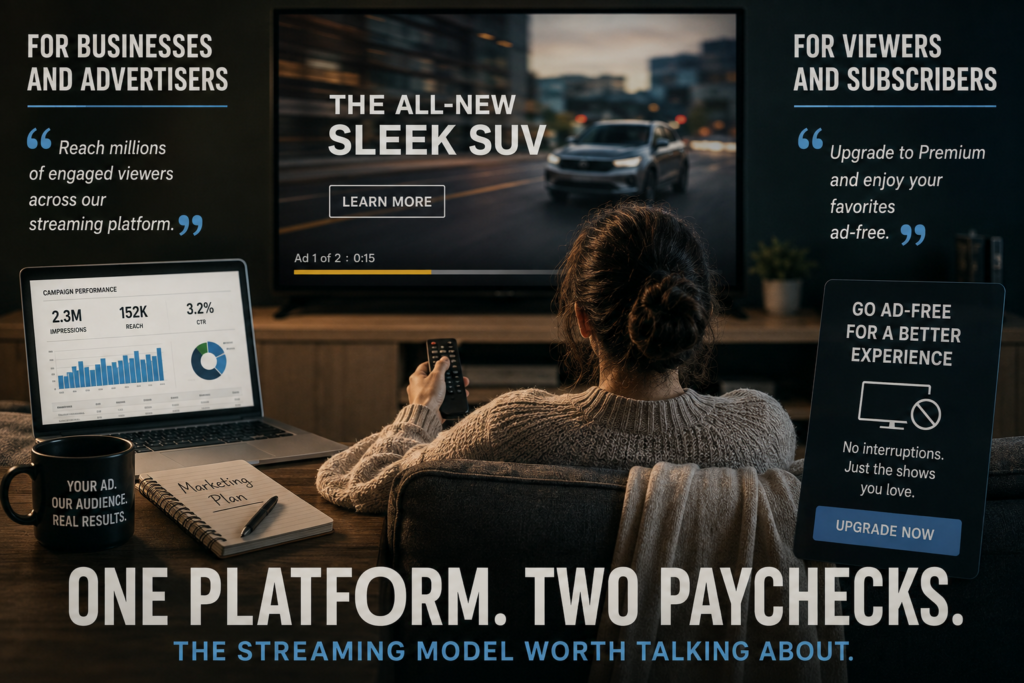
Streaming companies sell advertising to businesses based on their ability to put those businesses in front of a large audience. At the same time, many of those same companies offer their subscribers the ability to pay more to avoid the advertising.
The more we talked about it, the more interesting the business model became.
On one side, the streaming company is essentially telling advertisers:
“Pay us to get your message in front of our viewers.”
On the other side, they are telling viewers:
“Pay us more and you won’t have to see those advertisements.”
Either way, the streaming company gets paid.
Now, before anyone gets too excited, I am not suggesting there is anything illegal or necessarily deceptive happening here.
In fact, major advertisers and advertising agencies probably understand this model very well. Streaming companies generally sell advertising based on their ad-supported audiences, impressions, demographics, targeting and other measurements—not simply their total number of subscribers.
But that led our discussion to another question.
Does the average business owner understand that?
If you are a local or regional business spending thousands of dollars on streaming advertising, what exactly are you buying?
Are you being presented with the total number of subscribers on the platform?
Or the number of subscribers who actually receive advertising?
More importantly, how many of those people are actually potential customers for your business?
Those are very different numbers.
And then there is another part of this that I find fascinating.
Are the interests of the streaming company and the advertiser completely aligned?
The advertiser wants as many qualified people as possible to see the advertisement.
The streaming company certainly wants advertising revenue.
But the streaming company can also generate additional revenue from customers who want to avoid advertising.
That’s an unusual relationship when you think about it.
Imagine a newspaper approaching a local restaurant and saying:
“We have thousands of readers. Pay us to put your advertisement in front of them.”
Then imagine that same newspaper approaching its readers and saying:
“For a few extra dollars, we’ll remove the advertisements before we deliver your newspaper.”

As the restaurant owner, wouldn’t you at least have a few questions?
Streaming advertising obviously doesn’t work exactly like newspaper advertising. Advertisers purchase impressions, targeted audiences, campaigns and measurable results. Modern streaming platforms can also offer incredibly sophisticated targeting capabilities that traditional advertising never had.
That could make streaming advertising extremely valuable.
But it also means businesses need to become more educated buyers of advertising.
Instead of asking:
“How many subscribers do you have?”
Maybe businesses should be asking:
“How many people can actually see my advertisement?”
Then:
“How many of those people match my ideal customer?”
And:
“How many times will my advertisement actually be shown?”
And perhaps the most important question:
“How will you demonstrate that my advertising worked?”
Those questions aren’t just for streaming companies, either.
Businesses should probably be asking them of Facebook, Google, television stations, radio stations, newspapers, digital marketing companies—and yes, even local media platforms.
If someone is asking you to spend your marketing dollars, they should be able to explain what you are buying.
Our conversation that day didn’t end with us deciding streaming advertising was good or bad.
Actually, it ended with more questions than answers.
And maybe that’s the point.
I think this is something worth exploring further, particularly from the perspective of small and local businesses.
How transparent are streaming companies about their actual advertising reach?
How much does it cost to reach a specific local market?
What does $1,000 in streaming advertising actually buy?
What about $5,000?
How accurately can these platforms target a community like Great Falls, Montana?
And how does that investment compare with Facebook, Google, local television, radio, print or locally owned digital media?
I don’t know the answers to all of those questions yet.
But I would like to find out.
Because there is something fascinating about a business model where one customer pays you to show the advertisement, while another customer can pay you more to not show them the advertisement.
Maybe it works incredibly well for everyone involved.
But if you’re the business paying for those ads, I think it’s worth understanding exactly how the game works before you put your money on the table.